Top 5 Tips for Stunning 3D House Rendering Designs?
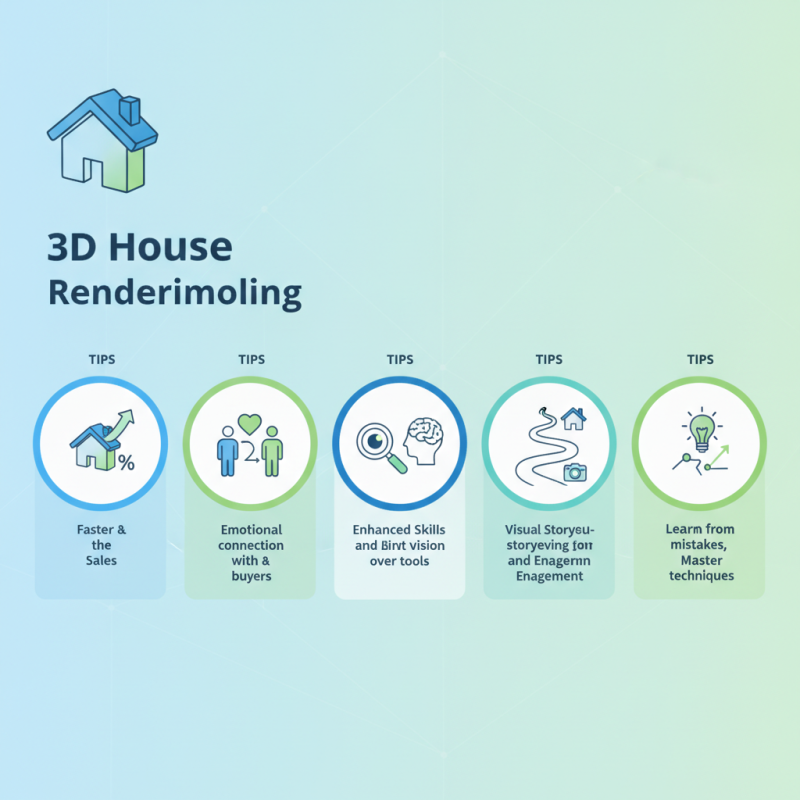
3D house rendering has revolutionized architectural visualization in recent years. According to a report by the National Association of Realtors, properties with 3D renderings sell 30% faster than those without. This data underscores the importance of high-quality visuals in real estate marketing. Industry expert Sarah Thompson, a leading figure in 3D house rendering, emphasizes, “Visually compelling designs can create emotional connections with potential buyers.”
The shift to digital technologies has heightened competition. Architects and designers must enhance their skills to stand out. While great software exists, the key lies in the artistry behind it. Many creators fall short because they focus too much on tools rather than their vision. In the world of 3D house rendering, storytelling through visuals can genuinely engage viewers.
Mistakes can be costly. Poor lighting or unrealistic textures can detract from the overall design. It’s essential to learn from these missteps while refining one’s approach. The journey of mastering 3D house rendering is ongoing. With the right techniques, anyone can transform standard designs into breathtaking displays that capture attention.
Understanding the Importance of 3D Rendering in Modern Architecture
In modern architecture, 3D rendering has become vital. A recent study indicates that 85% of architects believe 3D models enhance their communication with clients. These visualizations allow clients to grasp designs more intuitively. With stunning visuals, clients can experience the space before construction. This boosts satisfaction and reduces revisions.
Creating effective 3D house renderings involves specific techniques. For example, incorporating realistic lighting can dramatically change how a design feels. Pay attention to materials. High-resolution textures make a house look inviting. Color schemes also influence perception. Utilize complementary colors to create harmony in a design.
Details matter. Great renderings capture the essence of a space. They illustrate not only the build but also the surroundings. This context is essential for clients to see how their future home fits into the environment. Regularly seeking feedback during the design process can uncover flaws early. This continuous improvement leads to better final outcomes and reinforces the importance of 3D rendering in contemporary architecture.
Top 5 Tips for Stunning 3D House Rendering Designs
| Tip |
Description |
Benefits |
| Use High-Quality Textures |
Incorporate realistic textures for walls, roofs, and floors to enhance the visual appeal. |
Creates a more lifelike representation and attracts viewer interest. |
| Focus on Lighting |
Utilize natural and artificial lighting to bring depth and realism to your renderings. |
Improves mood and ambience, making designs more relatable. |
| Incorporate Landscaping |
Add trees, plants, and other natural elements to frame the house design. |
Enhances overall aesthetics and shows context. |
| Choose the Right Angle |
Select angles that highlight the best features of your design. |
Maximizes impact and grabs attention effectively. |
| Use Realistic Colors |
Apply color schemes that reflect real-world materials and settings. |
Makes the design more believable and appealing to clients. |
Key Software and Tools for Creating High-Quality 3D House Renderings
Creating high-quality 3D house renderings requires the right software and tools. According to a recent industry report, 75% of architects and designers prefer software that integrates smoothly with their workflow. Popular tools include SketchUp, Blender, and Autodesk Revit. These applications offer robust features for modeling, rendering, and visualization.
Using these tools effectively involves mastering lighting, texturing, and perspective. A survey indicated that 62% of designers believe proper lighting is crucial for realism. Moreover, 3D renderings that prioritize detail and texture tend to attract more client interest. Eye-catching visuals often lead to better project bids.
However, challenges still exist. Many designers encounter difficulties in achieving accurate materials or lighting effects. A lack of understanding in color theory can result in flat images that fail to impress. Periodic reflection on rendering techniques and trying new tools is essential for continuous improvement. Embrace these opportunities to enhance your skill set, despite the occasional frustrations that come with the design process.
Essential Techniques for Realistic Lighting in 3D Renderings
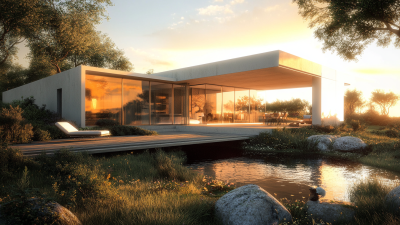
Realistic lighting is crucial in 3D house rendering designs. A thoughtfully crafted lighting setup can elevate a project from ordinary to extraordinary. According to industry reports, over 70% of viewers are influenced by lighting quality when assessing a rendering's realism. To create convincing environments, it is essential to consider natural and artificial light sources.
Utilizing global illumination techniques is one way to enhance realism. This method simulates how light interacts with surfaces, creating depth and texture. Additionally, implementing light probes can capture light information from the environment, leading to more authentic reflections and shadows. However, a drawback exists: poorly set light parameters can result in an unrealistic scene, making trial and error vital.
Adding ambient occlusion is another technique that contributes to realistic rendering. This process adds depth by simulating how light reaches different parts of a scene. Lack of attention to detail can lead to oversaturated areas or harsh contrast, which may detract from overall realism. Professionals should remain vigilant, as the right balance can significantly enhance the final outcome.
Top 5 Tips for Stunning 3D House Rendering Designs
Incorporating Texture and Material Effects for Greater Realism
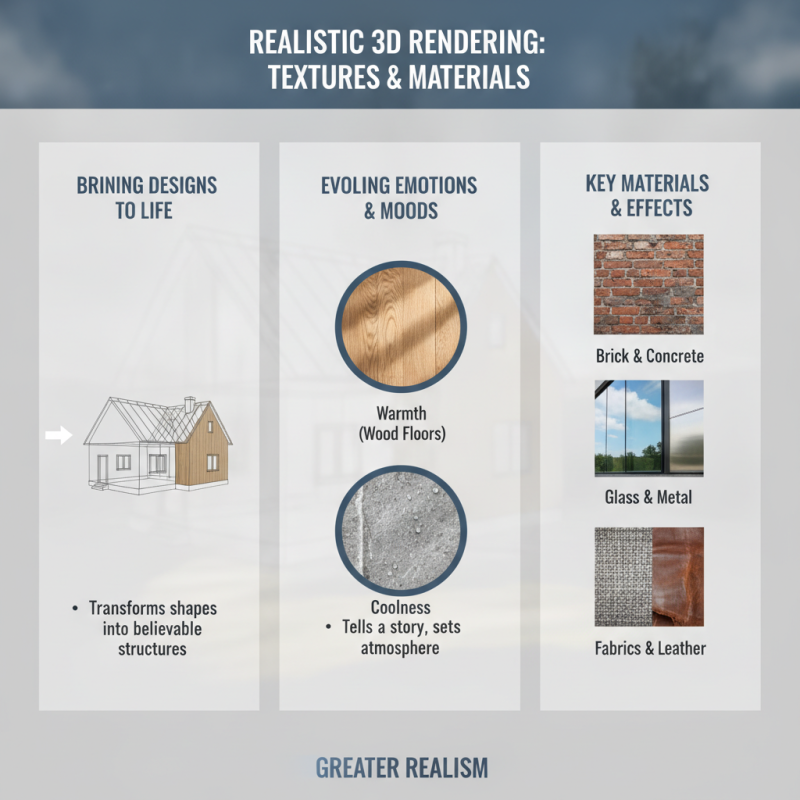
Creating a realistic 3D house rendering depends heavily on textures and materials. These elements breathe life into designs, turning mere shapes into believable structures. The right texture can convey warmth in wooden floors or the cool look of stone. When combined effectively, these materials tell a story, evoking emotions and setting moods.
However, achieving true realism is tricky. Many digital artists make common mistakes. They often overlook subtle variations in texture that occur in real life. A flat, uniform surface lacks the depth found in nature. Incorporating imperfections, such as scratches or subtle color variations, adds authenticity. Observing real-world materials helps in replicating these details digitally.
Lighting also plays a crucial role. Proper lighting can enhance textures, making them appear more dynamic. Experimenting with shadows can reveal the depth of materials as they interact with light. Yet, many forget to adjust these settings after rendering. The final image might fall short of expectations if this step is skipped. It's essential to review and refine, aiming for the perfect balance between elements.
Optimizing 3D House Renderings for Various Digital Platforms and Formats
In the realm of 3D house rendering, optimization for various digital platforms is crucial. A study by the Architectural Visualization Association indicates that over 70% of visual content is consumed on mobile devices today. This shifts the focus to ensuring renderings look stunning on smaller screens. Resolving resolution issues is essential; images should be no less than 1920 pixels wide to guarantee clarity.
Different formats also play a vital role in the presentation. JPG files are typically used for websites due to smaller sizes. However, for high-quality print, TIFF files are superior despite their larger size. Balancing quality and performance is often a challenge. Renderings can lose detail if overly compressed for web use. It’s essential to strike a balance where images remain visually appealing without compromising loading speed.
Moreover, interactive 3D models are gaining traction in online showrooms. According to a recent report, over 60% of buyers prefer engaging with 3D content during their journey. The integration of AR tools can elevate user experience, but this requires careful planning and execution. Not all designs translate seamlessly into 3D environments, which necessitates continuous testing and refinement. Effective rendering is an evolving process that requires persistent reflection and adaptation from designers.